Denver, Colorado · Bilingual English / Spanish
Timothy Myers
Paralegal / Software Engineer
Available for hire — seeking a full-time role, not selling a product
I'm looking to be hired — not to sell you a product or service. As one employee, I'd cover two roles a small firm usually can't justify separately: the paralegal casework and the technology behind it — the case-management tools, the automation, and (where it helps) private AI that runs in-house, so client data never leaves the building.
The idea
One person, two jobs — plus the piece most firms are missing
Small and mid-sized firms need substantive paralegal help and someone to run their technology, but rarely enough of either to justify two hires. I do both — with the technical judgment to keep a firm's systems running and, where it helps, set up tools a firm can actually trust with client files.
Substantive casework, in-house
Medical chronologies, records requests, discovery organization, and filing calendars — currently about halfway through Colorado paralegal coursework (no state license required).
10+ years building software
Roles across enterprise, SaaS, and legal software — including case-management tools at Davis Graham & Stubbs, one of Colorado's largest firms. I'd keep the tools, automation, and systems running in-house, so there's no separate IT contract.
Why this matters right now
The right tool can draft a medical chronology in minutes — but the common shortcut is uploading protected health information to a third-party cloud, which many firms won't accept, and rightly so. Run it locally, on the firm's own hardware, and you get that speed with the privacy of a filing cabinet. Someone has to set that up and run it responsibly. That's the role.
A sample of my work
Medical chronologies, built and run in-house
One example of the tooling I can build for a firm: raw provider records in, an attorney-ready medical chronology out, with zero client data leaving the machine. Modeled on a typical personal-injury matter — the kind of case any Colorado firm handles.
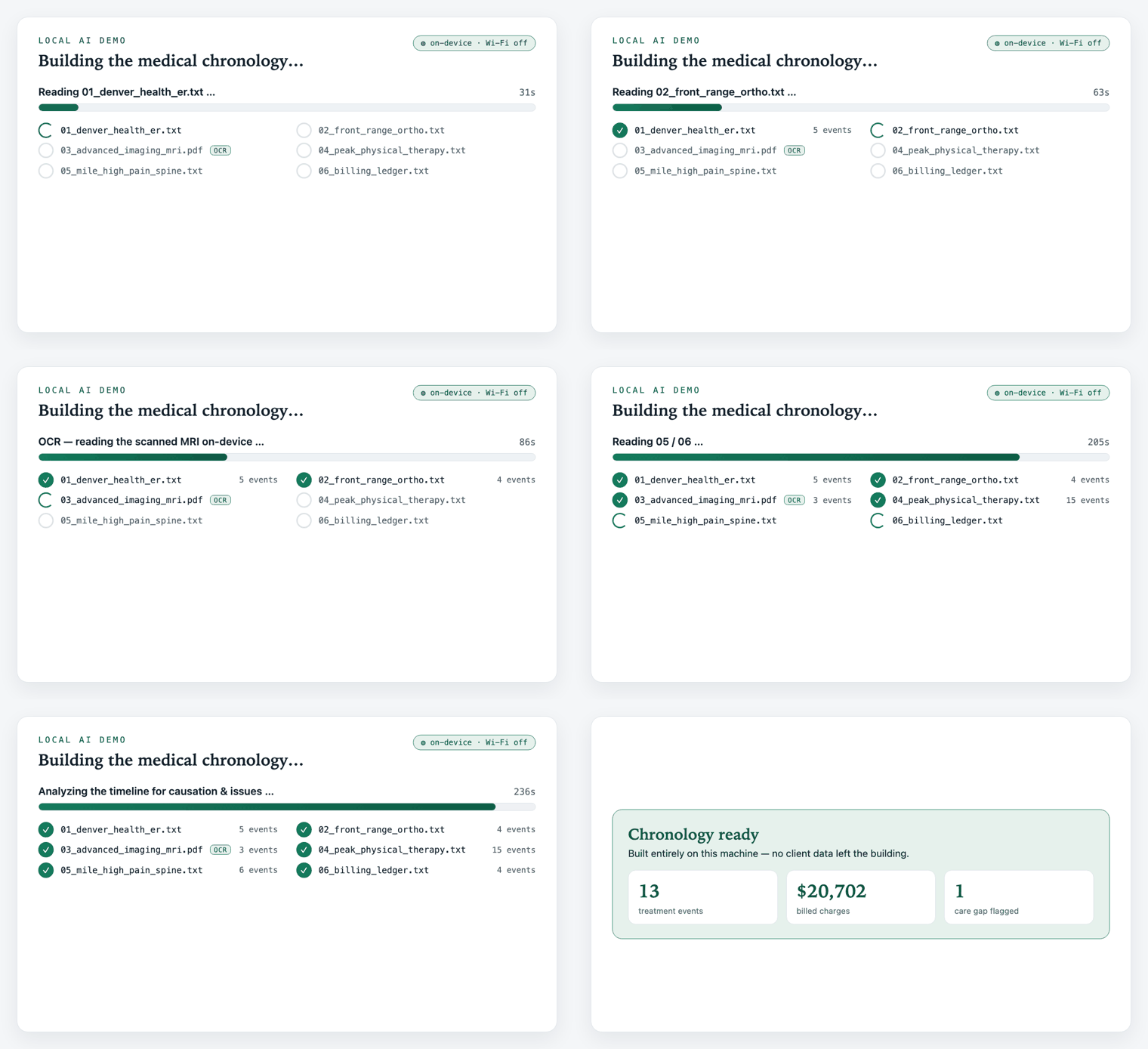
- Reconciles 6 providers into a single date-ordered timeline of 13 treatment events, each citing its source (Bates) page.
- Reads records however the firm has them — typed notes or scanned PDFs, OCR'd on-device with Apple's Vision engine.
- Sums $20,702 in billed charges and flags a 33-day gap in treatment — all computed in code, not guessed by the model.
- Surfaces causation statements and defense vulnerabilities (pre-existing findings, missed visits) for the attorney to weigh early.
Case-management software · Davis Graham & Stubbs
Built and maintained the firm's case-management software (2022–2024) — production legal technology used daily by attorneys and staff. The same domain this demo is built for.
Experience
A decade-plus in software, now adding the law
.NET Developer
- Enterprise .NET applications for loyalty and engagement platforms.
Software Developer
- Built and maintained internal legal software for one of Colorado's largest law firms.
Earlier software roles
- Full-stack and enterprise development at Envision Radiology, JBS, FRONTSTEPS, and others — including two cross-platform mobile apps shipped in Xamarin.
What I bring
Skills across both sides of the desk
Engineering
- C# / .NET
- Full-stack web
- JavaScript
- SQL
- Xamarin (iOS/Android)
- Document automation
- Case-management systems
Legal & paralegal
- Medical chronologies
- Records requests
- Discovery organization
- Filing calendars
- Confidentiality-first workflows
Languages & approach
- English (native)
- Spanish (native-level)
- Private / on-prem tooling
- Data-privacy by design
Common questions
What a firm usually wants to know
Is the AI accurate enough to trust?
Every chronology is a draft for paralegal review, not a filing. The model reads and organizes; the dates and dollar totals are computed in code and cite the exact source (Bates) page, so your team verifies each line against the record. The human stays in the loop.
Does it work with our existing case-management system?
Yes. It runs alongside whatever you already use and produces standard Word and PDF deliverables — nothing to rip out or replace.
What hardware does it need?
An ordinary computer. The demo runs on a 16 GB laptop — no servers, no GPU, no special IT project.
Is it confidential? What about HIPAA?
The model runs on your own hardware and never contacts a cloud service. You can prove it by pulling the internet and watching it still work — client data never leaves the building.
Is this a product you're selling us?
No. I'm offering to be the in-house hire who builds and runs this — and does the paralegal work day to day. The tools are open-source and local; the value is one person who understands both the law work and the technology.
Let's talk
Open to a salaried hybrid role with a Colorado firm
Fifteen minutes is enough to show you the demo running on your own hardware — records in, chronology out, nothing leaving the room.
I'm seeking a salaried role at $30–40/hour ($60,000–80,000/year) — a low rate for a firm that's getting a paralegal and a software/IT professional in a single hire.